Circular Agricultural Model

Menú

CAM integrates advanced production systems and local value chains to build sustainable agricultural clusters designed for long-term environmental and economic performance.

01

Strengthen food security and reduce dependence on imports.

02

Optimize land, water, and energy through advanced technologies and circular resource use.

03

Generate skilled employment and entrepreneurial ecosystems.

04

Improve environmental performance by reducing water consumption, carbon emissions, and waste.

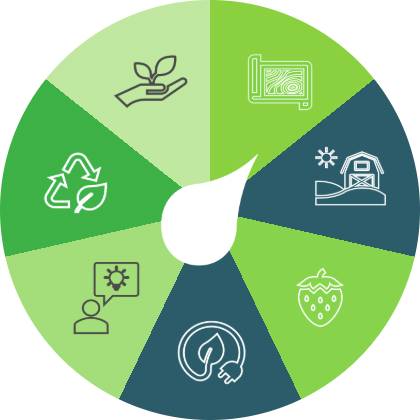
The Circular Agricultural Model​

  1. Land Recovery Recover unproductive land that´s been overused.
  2. Farm Design Define which hydroponic system/production process is the most adequate for the project.
  3. Local Supply Harvest the products needed, when they are needed. We ensure the maximum freshness and quality.
  4. Energy & Resources Efficiency Combine different sources of energy, (Solar, Electricity & Gas) depending on the project. We minimize the use of water in a 85%. Projects can be designed to recover and utilize CO2 during the photosynthesis process of the plants.
  5. Landscape revival In semi-desertic areas with limited green landscape, collaborating with the community to establish local forests or olive tree farms serves the dual purpose of absorbing CO2 and producing consumable products while promoting environmental care.
  6. Reuse Waste Our priority is to reuse approximately 85% of waste by recycling water, organic nutrients, and organic waste, while also exploring new applications for various production process by products such as plastics.
  7. Knowledge Transfer Train local talent to run the farm operations and all it´s technology, creating Job opportunities and personal development.

icono
icono
icono
icono
icono
icono
icono
Circular CAM Model

The Circular Agricultural Model

The CAM model covers all the different stages of an Agricultural Project

00

Strategy Plan, analyzing the Local needs and priorities to cover agricultural supplies.

Production Control
01

Analysis of locations to identify the ideal setting to build a Green House.

02

Definition of the engineering needs to prepare all the infrastructure: Water supply, Electrical access to green house, Loading areas, Working areas, Control systems (temperature, humidity…)​.

Production Control
03

Production design based on specific varieties of vegetables and fruits to be grown and cultivated​.

04

Latest agricultural Technology applied to the low water consumption production model and management​​.

05

Quality Control, our team stays with the local project team during the first harvesting and further on, to guaranty the success of the farm.

06

Training for all levels of employees; from engineers to basic skill works​.

07

Packaging of final products​.

08

Definition and coordination of logistics for final goods​​.

CAM Model:​ Benefits for the Agricultural Sector

It ensures a sustainable supply of high-quality fresh food while developing communities, creating wealth and knowledge, and protecting the environment​.

Production Control

Production Control

  • Farmers grow what they need, when they need it.
  • Self-sufficiency. No threat of unexpected supply problems by guaranteeing planned production with reliable output.
  • Opportunity to develop vertical integrations with distribution and institutional customers.
Production Control

Cost Control

  • Perfect control of all production parameters
  • No interference from third parties
  • Better margins for farmers
  • Reduced dependence on imports
Production Control

Product Freshness

  • Natural maturing of the products
  • Consume produce at the right time, maximizing their nutritional value
  • No handling by third parties to avoid possible contamination
Production Control

Local Development

  • Diversifies local economies by providing stable jobs
  • Women and young adults are targeted for employment and vocational education
  • Allows previously unusable land to become productive
Environmental Sustainability

Environmental Sustainability

  • 85% less water consumption
  • Reduced carbon footprint through proximity harvesting
  • Natural pest control
  • Organic nutrients are used and recycled, avoiding contamination of aquifers
Space Optimization

Space Optimization

  • Higher density of plants per acre: x4 or x6 times traditional agriculture
  • Higher yield per acre than outdoor cultivation
  • More efficient use of greenhouse space
Increased Productivity

Increased Productivity

  • Perfect control of all production parameters and their costs
  • Technology and smart greenhouse design reduce non-productive time
  • Biological pest control
  • Year-round cultivation and harvesting
  • Better margins
Faster ROI

Faster ROI

  • Very early maturing of the plant: 2–3 weeks before
  • First harvest 30–60 days after planting
  • Consistent crops year-round
Increased Efficiency

Increased Efficiency

  • Hydroponic systems improve ventilation and reduce humidity issues
  • Applied technology reduces costs and improves production and food safety management
New Business Opportunities

New Business Opportunities

  • Diversification of crops
  • Creation of a local green market
  • Cross-selling complementary agricultural products
  • Allows previously unusable land to become productive

Start Your CAM Project
Contact Us